Where roof and chimney, wall or vent come together
Chimney and wall flashing leaks in Harrison
Flashing is the metal strip sealing each joint between a roof and a chimney, wall or vent, and leaks tend to start there. Your move: call (862) 418-5296 and say which wall or chimney the stain sits near.
Back away and get help if
- Loose bricks or a chimney top that looks shifted after wind: keep everyone from standing under it, and dial 911 if anything has fallen.
- Smoke or a burning smell near the fireplace: leave the house and dial 911.
- Caulk gun in hand and a joint to seal: do not go up. A ladder near wires and a wet roof is a bad pairing, so the climb belongs to a roofer.
- A wire down near the chimney: stay back and dial 911.
Step flashing, counterflashing and the mortar joint
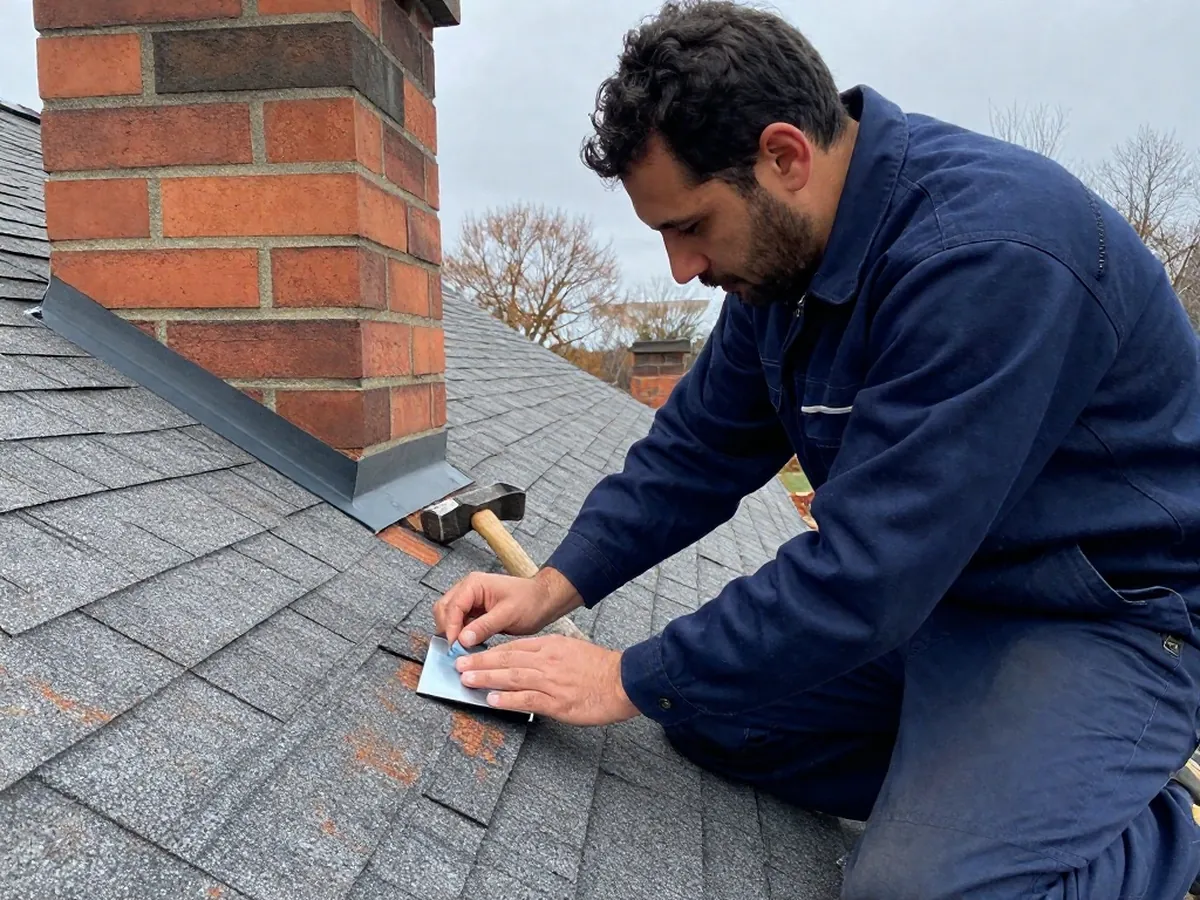
Where shingles meet a chimney or wall, step flashing is woven into the shingle courses, and counterflashing above it covers the top edge. The National Park Service warns against depending on caulks, sealants or goop to do that job, and advises checking the metal yearly.
On brick, the counterflashing is set into the mortar joints, per the Department of Energy's chimney page. Where a roof-to-wall joint ends, a kick-out piece sends water into the gutter. For step flashing, the Building America Solution Center cites the residential code's minimum of 4 inches high and wide.
Around Harrison and next door
Attached homes share walls, and every spot where a roof meets a wall needs flashing. The Census Bureau counts 443 attached single-family homes in Harrison, give or take 165.
East Newark counts 826 homes, 400 of them in two-family buildings (give or take 100), on a borough the town's own history puts at 64 acres. Roofs, walls and chimneys sit close together there.
Freeze, thaw and the caulk line
Newark Airport's January average of 32.8 degrees sits right on the line where water freezes and thaws. A joint with a gap lets that cycle work on the wall behind it.
A look at the chimney and the wall joints each spring, with binoculars on a dry afternoon, catches what winter did.
What to look at with feet on the ground
Everything here can be done from the ground or through a window. A job that needs a ladder belongs to the roofer.
- Stand back and study the chimney and any wall that rises above the roof. Look for a gap, a bent strip of metal or a smear of old sealant along the joint.
- Trace the stain upstairs. A mark on a wall or ceiling near a chimney, a dormer or a bump-out points toward that joint.
- Look at a brick chimney for crumbling mortar at the top or at the roofline. The Department of Energy's building-science page says the flashing is embedded in the mortar joints.
- Check the siding below a roof-to-wall joint for water staining, where roof water may be running behind it.
Contract questions for flashing work
New Jersey's rules for home improvement contracts call for a written contract on work above $500, and they bar starting work before any required permit is issued. Changes go in writing.
Checking a contractor lists what the contract names.
Ready to describe the roof?
Ready for the call: the street address, where the damage shows and a guess at the roof's age. Dial (862) 418-5296. Renters: the dated photo goes to your landlord or property manager at the outset. Covered: Harrison, Kearny, East Newark and Newark.
Call (862) 418-5296