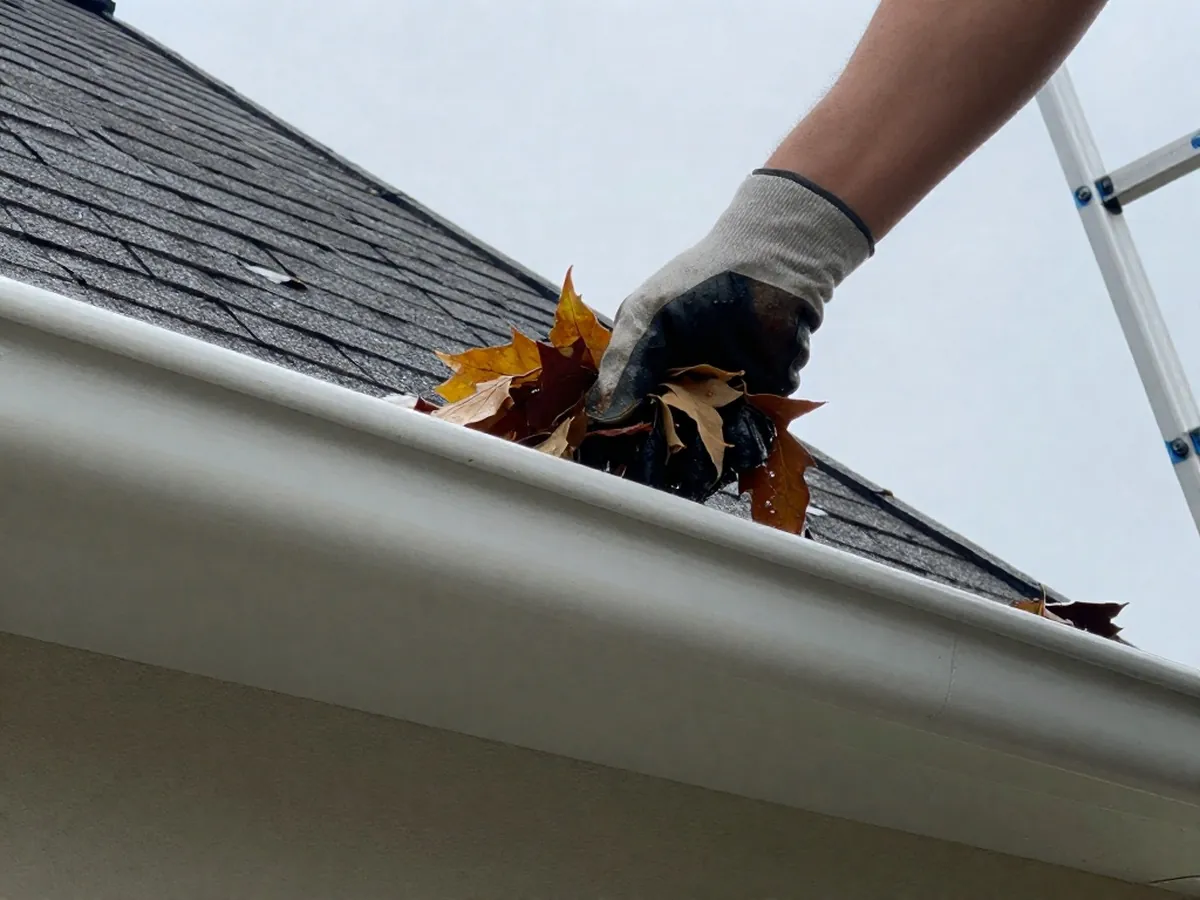
From shingle to gutter
Rain lands on the shingles and runs down the slope to the roof edge. At a wall, a kick-out piece of flashing steers the water into the gutter instead of letting it run down the siding. The Building America Solution Center describes the detail for existing homes. The gutter carries the water along the edge to a downspout, which is where the roof's runoff gathers into one stream.
The path in five stops
- Shingle: rain lands and runs down the slope.
- Roof edge: water meets the gutter, and at a wall a kick-out piece of flashing steers it in.
- Downspout: the whole roof's runoff arrives as one stream.
- Ground or drain: the water either soaks in, runs off or enters a pipe.
- Sewer: in a combined system, storm water and household sewage share the pipe.
What an inch of rain does to 800 square feet
Rutgers works the sum this way: a roof of 800 square feet, emptying through a single downspout, sends roughly 500 gallons down it during a one-inch rain. Stretch that to the 3.65 inches of the heaviest hour of Ida's remnants at Newark Airport, and the downspout is handling about 1,800 gallons. It is arithmetic, and a real roof will vary. The useful part is the order of magnitude.
What a combined sewer is
A combined sewer carries household sewage and storm water in the same pipe. Harrison's 2020 master plan says a majority of the town is served that way, and it lists six active combined-sewer overflows into the Passaic River. It also notes drainage-capacity problems near Angelo Cifelli Drive and Bergen Street. A downspout that feeds the sewer sends its share into that system.
Where a downspout can end
EPA's page on redirecting downspouts says they may connect to the sanitary sewer or the storm drain. It adds that disconnecting one may not suit every location, so local regulations count. Rutgers advises redirecting to ground that can soak the water in. On a narrow lot such a spot may not exist, and then the question belongs to the town office and the roofer together.
Flat roofs and ponding
Without a pitch to shed water, a flat roof leans on its drains and seams. Ponding, in the asphalt roofing trade group's definition, is water that is still there after 48 hours. The group puts the lowest workable slope at a quarter inch of fall for every foot, and names clogged drains among the causes. A look from an upstairs window a day or two after rain shows whether the roof is holding water.
Reading your own water path
Watch the outside of the house during the next steady rain, or look out a window. Where does the water leave the gutter, and where does it land? Does it pool, run toward the foundation or head for the street? Photograph any spill with the date. A roofer can use those pictures, and Harrison's Construction & Engineering office at 973-268-2446 is the place to ask whether a change to drainage needs paperwork.
Is water spilling or pooling at your house?
Gutters that spill are covered under gutter repair, and standing water on a low roof under flat roof repair. Your move: call (862) 418-5296 and name the downspout or the corner where the water misses.